

Precision sheet metal manufacturing isn’t the flashy part of railway innovation. There’s no ribbon-cutting ceremony. But it’s doing something real: it’s making trains lighter without making them weaker, & that changes the economics of the entire business.
Here’s the thing: a 5% weight reduction in a coach means less fuel burned, fewer emissions & less strain on the tracks themselves. For an operator running 100 coaches across multiple routes, that’s not theoretical – it’s millions of dollars over a decade. And that’s before you count the infrastructure savings.
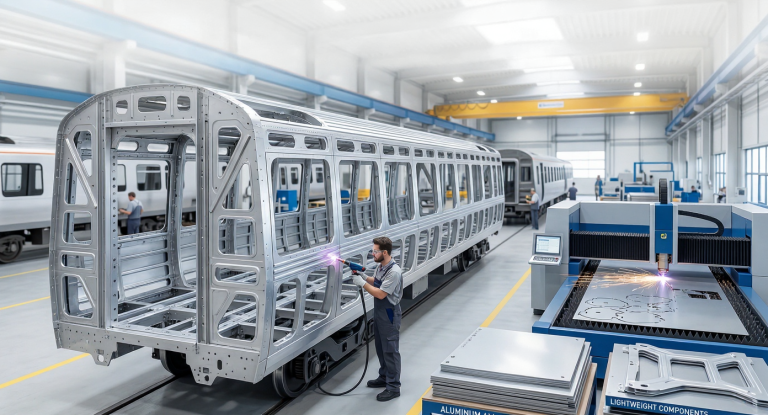
Most manufacturers still do this the old way: build it thick, reinforce it extra, and hope the tolerances work out. Precision sheet metal takes a different approach. You use exactly the right thickness in exactly the right places. The result: 10–15% weight savings on components that matter, without trade-offs.
Precision sheet metal isn’t magic. It’s the opposite of guessing.
Instead of conventional welding and riveting, precision methods use laser cutting and CNC equipment to hit tight tolerances from the start. Hydroforming creates complex shapes without the waste. Robotic assembly means joints are consistent. CAD modeling lets engineers test geometry before production even starts.
The payoff is waste elimination. Traditional fabrication needs thicker material as a safety margin. Precision methods eliminate the margin because they eliminate the uncertainty.
You can also do things that are simply impossible the old way. Variable-thickness panels. Compound geometries. Shapes that combine strength and lightness in places you couldn’t engineer before.
The lightweighting happens across the whole coach:
Structural work: Side panels and roof sections engineered with varying thickness. Load-bearing areas stay thick. Areas under less stress get thinner. The result: stronger structure, less weight.
Interior components: Seats, luggage racks, partition walls. All manufactured with precision forming instead of added reinforcement. You save weight without sacrificing comfort or durability.
Frames: Doors and windows need to stay rigid but don’t need extra material everywhere. Optimized geometry cuts weight by 15–20% per component.
Brackets and supports: The small stuff. Fasteners, braces, corner pieces. When you precision-engineer dozens of these, the cumulative effect is real. 8–12% total weight reduction per coach.
The benefits are straightforward and measurable:
Fuel and energy use: Less weight means less energy to move the train. Diesel trains burn less fuel. Electric trains draw less from the grid. Both save money.
Infrastructure lasts longer: Lighter trains wear tracks and wheels more slowly. Maintenance intervals extend. That’s a significant cost for operators managing aging infrastructure.
Emissions drop: Lower fuel use means lower carbon output. It’s one of the few weight-reduction strategies that actually scales across a fleet.
Existing equipment works harder: Lighter coaches can run on existing locomotives instead of requiring new, more powerful (and expensive) machines.
Build quality improves: Tight tolerances mean less rework after assembly. Production becomes more efficient and consistent.
The transport industry isn’t moving toward lightweighting because of marketing. It’s moving because it works.
Precision sheet metal isn’t just cost optimization. It opens up design space. Engineers can try geometries and material combinations that were too expensive or too difficult to manufacture before. That means innovation in thermal management, noise reduction, passenger comfort all without weight penalties.
For operators, this capability is becoming table stakes. As sustainability commitments tighten and fuel costs stay volatile, the ability to run lighter, more efficient coaches is a real competitive advantage.
The transport industry’s shift toward lighter, more efficient solutions runs on one thing: actual engineering capability. Not regulation. Not marketing. Capability.
As rail operators commit to cutting emissions and controlling costs, the operators who can deliver precision, reliability, and scalability in lightweight manufacturing win. The question isn’t whether lightweighting matters anymore. It’s whether your manufacturing partner can actually execute it.
The next generation of railway coaches will be lighter and more efficient. Not because they have to be, but because it’s the better engineering choice.
This is where expertise in precision sheet metal manufacturing becomes essential. At Rishi Laser, we’ve spent years perfecting the processes that make lightweighting work at scale. Our experience in laser cutting, CNC forming, and robotic assembly combined with deep knowledge of railway coach design requirements means we understand both the engineering constraints and the practical realities of production.
We work with transport manufacturers who want to cut weight without cutting corners. That means tight tolerances from the start. It means designs that work in the real world, not just on paper. And it means manufacturing partners who understand that precision is the foundation of reliability.
If you’re evaluating lightweighting solutions for your railway operations or manufacturing, the difference often comes down to the precision and expertise of your partner. We bring both.